SERVING THE GREATER SAN DIEGO COUNTY AREA
SAN DIEGO: MISSION VALLEY, & RANCHO BERNARDO, CA
DURATION
1.5 Hours
NEED APPOINTMENT?
Yes
PRICE
$199
LEAVE A MESSAGE
What is PRP hair restoration?
PRP hair restoration restores hair growth by injecting platelets into your scalp. As the PRP flows into hair follicles, it heals and revitalizes the follicles, resulting in new hair growth.
Platelets are naturally present in your blood. When you suffer an injury or develop a disease, platelets automatically travel to the damaged tissues and release proteins called growth factors.
Growth factors then activate cellular activities that heal the tissues. The most essential of these activities are:
- Reducing inflammation
- Triggering new blood vessel growth
- Stimulating collagen production
- Recruiting cells to the area to regenerate new tissues
After your FIX Medical Group provider injects PRP into your scalp, growth factors accelerate and enhance all these healing activities. The follicles heal and start growing hair again, producing new hair that is thicker and healthier than before.
When would I need PRP hair restoration?
When you notice thinning or balding hair, consult the FIX Medical Group team about PRP hair restoration. PRP is derived from your own blood, so it’s safe, with no chance of side effects.
Though illness, nutritional deficiencies, autoimmune diseases, and wearing tight hairstyles lead to hair loss, the top cause in men and women is androgenetic alopecia. This inherited condition makes the follicles hypersensitive to a hormone (DHT). The DHT shrinks the follicles, halting hair growth.
Androgenetic alopecia, also called male-pattern and female-pattern baldness, causes distinct hair loss patterns. Men typically experience a receding hairline and hair loss on the top of the head, while women usually experience thinning across the entire scalp. If you’re considering PRP for hair growth, your provider can also discuss the PRP hair loss treatment cost and whether it’s right for you.
What happens during PRP hair restoration?
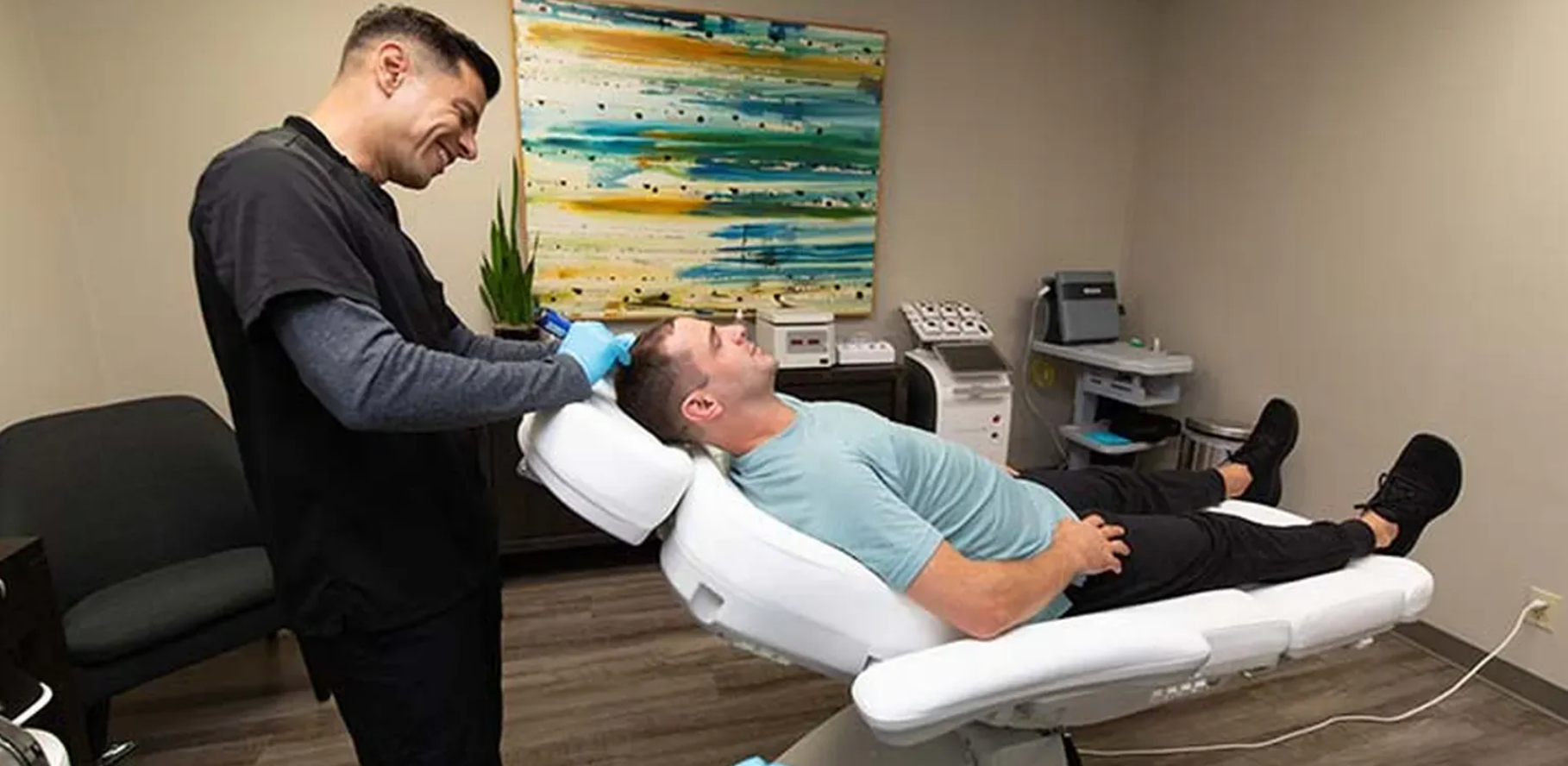
For the first step, your provider takes your blood and processes it in a centrifuge. The centrifuge separates the platelets and plasma, creating the PRP they use for hair restoration.
After applying a topical anesthetic to your scalp, your FIX Medical Group provider injects the PRP. Most patients need several treatments to get the best results with female PRP hair treatment. Your provider explains the process and gives you all the details before your first session.
If you have underlying conditions contributing to your hair loss, such as a nutritional deficiency, your provider may combine PRP injection for hair loss with other treatments to support healthy new hair growth.
Call FIX Medical Group today or connect online to request a consultation and learn if PRP hair restoration is the solution to your hair loss.

Frequently Asked Questions About PRP Hair Restoration
Can PRP hair restoration help with a receding hairline?
PRP hair restoration may help some people with early hair thinning around the hairline, particularly when the cause is androgenetic alopecia, also known as male or female pattern hair loss.
PRP is prepared from your own blood and contains a concentrated platelet fraction. These platelets release growth factors and signaling proteins that may influence existing hair follicles.
PRP works with follicles that are still present. It cannot reliably recreate follicles in an area that has been completely bald for years.
A scalp and hair-loss evaluation at FIX Medical Group can help determine whether the hairline still has follicles likely to respond.
Where can I get PRP hair restoration in San Diego?
FIX Medical Group offers PRP hair restoration in San Diego for appropriately selected patients experiencing hair thinning or certain forms of hair loss.
When comparing providers, don’t choose solely on price.
Ask about:
- Who performs the procedure
- How your hair loss is diagnosed
- Whether you’re actually a good PRP candidate
- How the PRP is prepared
- The recommended treatment schedule
- How progress will be documented
- What happens if you don’t respond
- Whether other hair-loss treatments should also be considered
PRP is a medical procedure, so a proper hair-loss evaluation should come before injections.
Can PRP hair restoration help with thinning at the crown?
Yes, the crown is one of the areas commonly treated with PRP in patients who still have active hair follicles.
Research on PRP for androgenetic alopecia suggests it may improve hair density in some patients, although results vary and study protocols aren’t standardized. A 2024 systematic review found potential benefit but also noted limitations in evidence quality and significant variation between studies.
Patients with thinning hair generally have a better biological target for PRP than areas where follicles are no longer viable.
Can PRP hair restoration improve hair density?
PRP may improve hair density for some patients with androgenetic alopecia.
A meta-analysis of randomized controlled trials found improvements in hair density at three and six months compared with placebo, although results for other measurements such as hair count and diameter were less consistent.
That means PRP is promising, but it shouldn’t be advertised as guaranteed hair regrowth.
At FIX Medical Group, the goal is to support existing follicles and monitor objective progress over time.
Does PRP hair restoration work on the hairline and temples?
PRP can be injected around the hairline and temple areas when viable follicles remain.
These areas can sometimes be more challenging because advanced recession may leave fewer follicles available to respond.
PRP cannot create an entirely new hairline where follicles are absent. Patients with significant recession may need to discuss other options, including medical hair-loss treatment or hair transplantation.
A scalp evaluation is the best way to determine what is realistically possible.
Can PRP hair restoration be used after a hair transplant?
PRP is sometimes incorporated into care before or after hair transplantation, but the timing should be coordinated with the surgeon or clinician managing the transplant.
The intention may be to support the scalp environment, healing, or existing follicles.
PRP shouldn’t replace the transplant surgeon’s postoperative protocol, and patients shouldn’t schedule scalp injections immediately after surgery without medical clearance.
What factors affect PRP hair restoration results?
PRP results can be influenced by:
- The cause of hair loss
- How advanced the hair loss has become
- Whether viable follicles remain
- Age and genetics
- Hormonal or medical contributors
- Nutrition and overall health
- Medications
- PRP preparation and treatment protocol
- Number and spacing of treatments
- Whether other appropriate hair-loss treatments are used
Perhaps the biggest factor is diagnosis.
PRP may be reasonable for androgenetic alopecia, but hair loss caused by thyroid disease, severe nutrient deficiency, autoimmune disease, scarring alopecia, medication effects, or another condition may require a completely different strategy.
How much does PRP hair restoration cost in San Diego?
The cost of PRP hair restoration in San Diego depends on the number of sessions recommended, the treatment area, the provider, and whether PRP is being combined with other hair restoration services.
Because patients may need an initial series followed by periodic maintenance, it’s worth asking about the total expected treatment cost, not just the price of one session.
FIX Medical Group can provide specific pricing after determining what type of treatment plan is appropriate for you.
Can PRP hair restoration be combined with red light therapy?
PRP may be combined with low-level light or red light therapy in some hair restoration plans.
Low-level light therapy has its own body of research for androgenetic alopecia and may be considered alongside other therapies. A broader 2024 systematic review of androgenetic alopecia treatments supported an individualized, multimodal approach rather than assuming one therapy works best for every patient.
That doesn’t mean combining PRP and red light therapy guarantees a stronger result. Your provider should determine whether both make sense for your type of hair loss.
How many PRP hair restoration sessions will I need?
There is no single universally accepted PRP hair restoration protocol.
Many published studies use an initial series of approximately three treatments spaced about one month apart, with follow-up or maintenance considered later. However, protocols vary considerably between studies and clinics.
At FIX Medical Group, the schedule should be based on your type of hair loss, response, and treatment goals rather than assuming everyone needs the same number of injections.
How long does it take to see results from PRP hair restoration?
PRP hair restoration isn’t an instant treatment because hair follicles move through slow biological growth cycles.
Visible improvement generally takes several months, not several days.
Clinical research often evaluates hair density around three to six months after treatment, which provides a more realistic expectation than looking for dramatic changes after the first few weeks.
Photos and other objective measurements can help determine whether density is actually changing over time.
Is PRP hair restoration painful?
PRP hair restoration involves multiple small injections into the scalp, so some discomfort is expected.
Patients often describe pressure, pinching, or brief stinging during treatment. Comfort measures may be used depending on the procedure.
Afterward, temporary scalp tenderness, sensitivity, redness, swelling, or a tight sensation can occur. These symptoms usually improve as the scalp settles.
Is there downtime after PRP hair restoration?
PRP hair restoration usually has minimal downtime.
Many patients return to work or regular daily activities soon after treatment. Your scalp may temporarily appear red or feel tender, and you may receive instructions about exercise, washing your hair, sun exposure, or hair products following treatment.
Follow the specific aftercare instructions from FIX Medical Group rather than assuming every clinic uses the same restrictions.
Who is a good candidate for PRP hair restoration?
PRP may be most appropriate for people with early to moderate androgenetic alopecia who still have viable, miniaturized hair follicles.
Someone noticing gradual thinning, a widening part, reduced density at the crown, or early recession may be a better candidate than someone with a long-standing area of complete baldness.
PRP may not be the right first treatment when hair loss is caused by an untreated medical condition or scarring process.
A proper diagnosis matters before treatment begins.
Are there side effects from PRP hair restoration?
Because PRP is prepared from your own blood, allergic reactions to the PRP itself are less of a concern than with many injected medications. That doesn’t mean the procedure is risk-free.
Possible effects include:
- Temporary pain or tenderness
- Redness
- Swelling
- Bruising
- Pinpoint bleeding
- Headache or scalp sensitivity
- Infection, although uncommon when proper sterile technique is used
Discuss medications, medical conditions, bleeding problems, and other relevant health information with your provider beforehand.
Does PRP work for all types of hair loss?
No.
The strongest interest and clinical evidence for PRP hair restoration centers on androgenetic alopecia, commonly called male or female pattern hair loss. Even within that group, not everyone responds.
Sudden hair shedding, patchy hair loss, scarring alopecia, autoimmune hair loss, or hair loss caused by illness, medication, thyroid problems, or significant nutritional deficiencies may require another treatment entirely.
If the cause hasn’t been diagnosed, that should happen before PRP.
Can PRP regrow hair on a completely bald scalp?
PRP primarily aims to support existing hair follicles. It isn’t a reliable way to recreate follicles that have been permanently lost.
If an area has been smooth and completely bald for a long time, a hair transplant may be a more relevant option to discuss.
This is why earlier thinning can sometimes be a better time to seek an evaluation than waiting until hair loss is advanced.
Is PRP hair restoration permanent?
PRP shouldn’t be described as a permanent cure for hair loss.
Androgenetic alopecia is typically progressive. If PRP helps improve density or support existing hair, maintenance treatment or other hair-loss therapies may be considered to help preserve results.
The long-term plan depends on your diagnosis, response, age, genetics, and other treatments.
Is PRP better than minoxidil for hair loss?
There isn’t enough evidence to say PRP is universally better than minoxidil.
They also work differently.
Minoxidil is an established medication for pattern hair loss, while PRP is an injectable procedure intended to influence follicular activity through platelet-derived signaling factors. Some patients may be candidates for one, the other, or a combination approach.
Treatment should be individualized based on sex, type of hair loss, medical history, tolerance, and goals.
Can PRP be combined with minoxidil or other hair-loss treatments?
Yes, PRP may be used alongside other hair-loss treatments when medically appropriate.
Depending on the patient, a treatment plan could involve PRP plus topical or prescription therapy, low-level light treatment, nutritional correction when a true deficiency is present, or other options.
Combination treatment can make sense because androgenetic alopecia is an ongoing condition, but more treatments aren’t automatically better. Each should address a specific part of the problem.
Does PRP hair restoration work for women?
PRP may be considered for women with female pattern hair loss, particularly when follicles are still present and thinning rather than completely lost.
Female hair loss deserves a careful evaluation because hormonal changes, thyroid disorders, iron deficiency, medications, stress-related shedding, and other medical issues can sometimes contribute.
A diagnosis should come before assuming all female thinning is genetic.
Does PRP hair restoration work for men?
PRP may help some men with androgenetic alopecia, particularly in earlier stages when miniaturized follicles remain.
Recent systematic reviews have reported potential improvements in hair density, although evidence quality and treatment protocols vary.
PRP won’t necessarily stop the hormonal and genetic process driving male pattern hair loss, which is why other treatment options may also be discussed.
What should I ask during a PRP hair restoration consultation?
A good PRP consultation should answer more than “How many sessions do I need?”
Ask:
- What type of hair loss do I have?
- Am I a good PRP candidate?
- Do I still have viable follicles?
- Should any medical causes be investigated?
- How will progress be measured?
- How many initial treatments do you recommend?
- Will I need maintenance?
- Should PRP be combined with another treatment?
- What results are realistic for my level of hair loss?
At FIX Medical Group, the objective should be the right hair-loss plan, not simply selling everyone PRP.